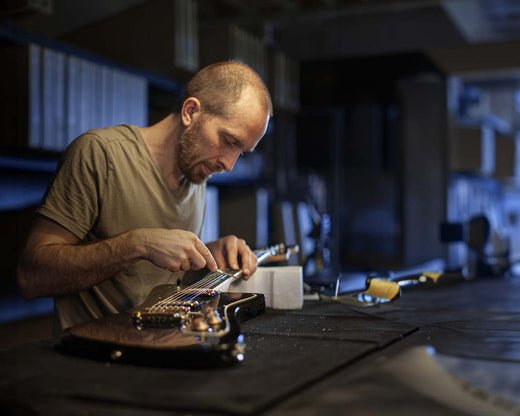
If you have spent any time looking at our electric guitars and basses, you have probably noticed that all of them feature a roasted maple neck. It has a warm, caramelized look that feels a little different from a regular maple neck the moment you pick it up. But roasted maple is not just about looks. There is a real reason we use it so much, and once you understand what it actually does, it is hard to go back.
It starts with the wood
Wood is a living material. Even after a tree is cut down and turned into a guitar neck, it keeps reacting to the world around it. It absorbs moisture when the air is humid, releases it when things dry out. That constant movement is what causes necks to shift, setups to drift, and tuning to go unstable when you move between environments.
Roasting is a way of stopping that cycle.
The process is exactly what it sounds like: the maple is placed in a specialized kiln and slowly baked at high temperatures — around 160 to 180°C — in a completely oxygen-free environment. The heat drives out the moisture, sugars, and organic compounds that make wood reactive. What is left behind is a denser, more stable, and lighter piece of wood that has essentially been fast-forwarded through decades of natural aging in a matter of hours.
Think of it like the difference between green wood and a well-seasoned piece that has been drying in a workshop for 40 years. The roasting process gets you to that second place, right from the start.
A quick word on the name
Roasted maple goes by several names: torrefied, baked, caramelized, thermally treated. They all describe the same thing. The guitar industry has not quite settled on one term, so you will see them used interchangeably. At Baum, we call it roasted maple, because that is simply the most honest description of what happens to it.
What you actually notice as a player
Your guitar stays in tune
This is the one players notice first. A roasted maple neck does not swell or contract with humidity and temperature changes the way an untreated neck does. Whether you are playing in a dry rehearsal room in January or a sweaty venue in August, the neck stays put. Your setup holds. Your tuning holds. You spend less time tweaking and more time playing.
The neck feels different. And in a good way
Because roasted maple is so stable, it does not need a thick protective finish on the back of the neck. We can leave it with just a very thin satin treatment, which means your hand is essentially touching the wood itself. It feels smooth, fast, and natural - like a neck that has been played in for years, right out of the box. No stickiness, no drag.
It sounds a little more alive
This one is harder to measure, but many players notice it. Roasting removes the moisture and organic material that can dampen the natural resonance of the wood. The result is a neck that transfers vibration more freely. It sounds slightly more open, with a faster response. It is not a dramatic transformation, but it is real. The neck feels like it is working with the strings rather than absorbing them.
Does it need special care?
Not really. Because the wood has already been through such a thorough drying process, it does not need oiling or conditioning the way an untreated rosewood or ebony fretboard might. A light wipe-down after playing is all it takes. The thin satin finish on the back of the neck handles the rest. It is genuinely low-maintenance which, for a touring or gigging player, is one more thing to appreciate.
You can explore all guitars and all basses with roasted maple necks here — or read on to understand what makes the look so distinctive.
The look
Roasted maple has a warm, golden-brown color that comes entirely from the caramelization of the wood's natural sugars during the baking process. No stains, no dyes — just heat and time. The color runs all the way through the wood, not just on the surface. You can sand it, shape it, or bevel the fret ends, and the color is still there underneath.
The shade can range from a light, honey-amber tone to a deeper, richer caramel brown. If the piece has any flame or figuring in the grain, roasting tends to make it pop even more as the caramelized sugars settle differently across the grain patterns, adding depth and contrast that you simply do not get with untreated maple.
There is also something about the texture. Roasted maple, finished with just a thin satin coat, has a slightly matte, almost silky surface that catches light differently from a gloss-finished neck. It looks like wood that has been played and cared for. It looks earned. That quality is difficult to describe, but you notice it immediately when you play one.
It is a look that feels both vintage and modern at the same time. Familiar, but with its own character.
At Baum, we use roasted maple exclusively for the neck, because this is the part of the guitar your hand lives on. All our fretboards are rosewood, a pairing we find gives you the stability and natural feel where you need it.
It is a deliberate combination, and one that works. See how it comes together across our lineup.
It is a deliberate combination, and one that works. See how it comes together across our lineup.
Why your neck might look different from someone else's
Here is something worth knowing: two guitars from the same model, roasted in the same batch, can come out with noticeably different shades. One might be a light golden-amber. Another might be a deeper, richer brown. Both went through the exact same process. So why the difference?
The answer is in the wood itself.
Every tree grows differently. The amount of natural sugar and sap stored in the wood, how densely the grain grew, which part of the tree the blank was cut from — all of these things vary from piece to piece, even within the same species.
When the wood goes into the kiln, those natural differences determine how it responds to the heat. A piece with more natural sugars will caramelize more deeply and come out darker. A piece with a tighter, denser grain may react more evenly and stay lighter.
It is the same reason two cups of coffee from the same roast can smell slightly different, or why two pieces of bread from the same loaf toast at slightly different rates.
The raw material is never perfectly uniform, and that is what makes it interesting.
One thing worth being clear about: the color difference is purely aesthetic. A lighter roasted maple neck and a darker one perform identically. The stability, the feel, the resonance, the low-maintenance finish — all of that is the same regardless of where your neck lands on the color spectrum. Darker does not mean more roasted, and lighter does not mean less. It simply means the wood responded differently to the same process, based on its own natural composition. You are not getting a better or worse neck either way, it is just a different-looking one.
A word on darker roasted maple
If you are looking at a particularly deep, rich brown neck and wondering how it got there, the answer is: time and temperature.
Achieving a darker roast means the wood spends longer in the kiln, or is taken to a higher peak temperature, to drive the caramelization process further. That extra time is also where something interesting happens: the natural variation between individual pieces of wood becomes more pronounced.
With a lighter roast, the process is shorter and the wood does not have as much time to diverge. Pieces tend to come out in a relatively narrow color range.

With a darker roast, the longer exposure to heat amplifies whatever is already there in the wood, more sugar means deeper caramelization, denser grain means a different rate of heat absorption, and so on. Two pieces that might have looked nearly identical at a lighter roast can end up noticeably different shades at a darker one. The kiln gives the wood more time to be itself, and wood is never perfectly uniform.

This is worth knowing if you are drawn to the darker end of the roasted maple spectrum. The look is stunning, but the range of what you might receive is naturally wider. Some necks will be a deep, even caramel. Others may show more variation across the surface, with areas of lighter and darker tone within the same piece. That is not a defect, it is the character of the material expressing itself more fully.
A note on color variation
Because the color of roasted maple is determined entirely by the natural properties of each individual piece of wood, it is something we cannot control or predict.
We do not stain, tint, or artificially darken our roasted necks to achieve a specific shade. To do so would compromise the very qualities: the feel, the stability, the natural finish that make roasted maple worth using in the first place.
What this means in practice: if you order a guitar with a roasted maple neck, the exact shade you receive may be lighter or darker than what you see in our product photos or on a friend's guitar. It will fall within the natural range of roasted maple (somewhere between a warm honey and a rich caramel brown) but the specific tone is nature's call, not ours.
We think that is a good thing. Your neck is a one-of-a-kind piece of wood. No one else has one that looks exactly like it. That is not a flaw - it is what you get when you build instruments from real materials.
Is roasted maple worth it?
Roasted maple necks cost a little more to produce than standard maple necks. The roasting process takes time, requires specialized equipment, and adds a step to manufacturing. That cost gets passed on, which is why you will sometimes see it listed as a premium option or a distinguishing feature on higher-spec instruments.
But from a player's perspective, the value is straightforward. A neck that stays stable means fewer setups, less time chasing your truss rod, and a guitar that plays the same in your living room as it does on stage. A neck that does not need a thick finish means a more direct, natural feel under your hand. And a neck that looks this good without any artificial treatment is simply a nicer thing to own.
We use roasted maple because it makes better guitars. Not because it is a trend or a talking point, but because when you put one in a player's hands, the difference is real.
Roasted maple is one of those things that sounds like a marketing term until you actually play a neck made from it. Then it just makes sense. It feels better, it stays stable, and it looks great doing it. That is why we use it.