We want our guitars to feel like wood. Not like plastic. Not like a product.
That sounds obvious, but it is actually a deliberate choice — and one that goes against how most production guitars are finished today.
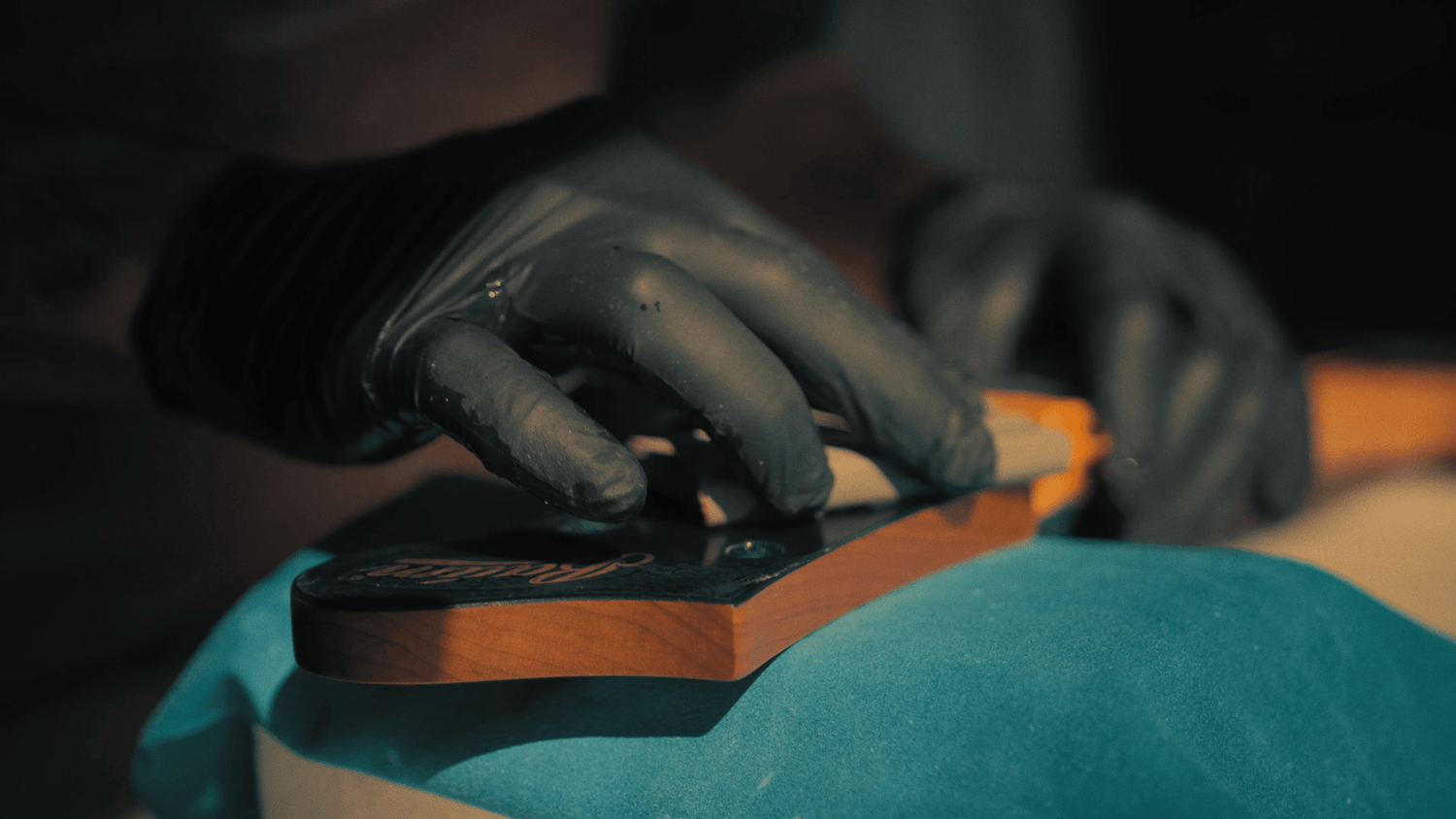
Our goal is to apply the thinnest possible layer of lacquer. Enough to protect the wood. Not so much that it buries it. Because whatever you wrap a piece of wood in changes how it behaves — how it rings, how it resonates, how it feels in your hands.
We use polyurethane lacquer, which is the modern standard. But we apply it with the philosophy of a vintage instrument: as thin as we can get away with, so the wood underneath can still do what wood does.
If you look closely at one of our guitars, you will sometimes see the grain of the mahogany showing through the surface. We consider that a feature. It is a sign that the finish is thin enough to follow the wood, rather than bury it.
But to understand why this matters — and why most guitars are finished differently — it helps to know a bit of the history.
Where it all started
For decades, the industry standard was nitrocellulose lacquer. It was adopted in the 1920s from the car industry, and pretty much every collectible guitar made before the mid-1960s left the factory with a nitro finish.
Nitro is a low-solids finish. A lot of the material evaporates as it cures, leaving behind a very thin, flexible film. Over time, it gets thinner still — sinking into the wood grain and developing that beautiful, tactile patina you see on vintage instruments.
It is a remarkable finish. But it has honest flaws: it yellows over time, it cracks when temperatures change, and it is hazardous to apply. By the late 1960s, most of the industry had moved to polyurethane. Not to ruin tone — but because poly is more durable, faster to apply, and far safer to work with.
The trade-off is that polyurethane is a high-solids finish. It goes on thick and stays thick. Applied generously, it seals the guitar in a hard shell. That is where things get complicated.
What a thick finish actually does
The acoustic guitar world has always understood this. Spray a heavy coat of lacquer over a spruce top and you dampen the vibration. The guitar sounds choked. This is why acoustic luthiers obsess over finish thickness — every gram counts.
The same physics apply to a solid-body electric. The effect is less dramatic, but it is real. A thick, heavy finish restricts how the wood rings and responds. It adds weight. And it changes the feel of the instrument in your hands — that sense of connection to the wood underneath.
The mahogany factor
This is where our choice of wood makes things more interesting.
Mahogany has a large, open pore structure — very different from close-grained woods like alder or maple. When you spray lacquer over mahogany, the finish sinks into those open pores as it cures. The grain telegraphs through the surface.
The easy fix is to use heavy grain filler, a thick primer, and enough lacquer to bury it all flat. You end up with a perfectly smooth, glass-like surface.
But you also end up with a guitar that feels more like plastic than wood. More weight. Less resonance. Less of what made the mahogany worth choosing in the first place.
We do not like that trade-off.
The Baum approach
We use polyurethane because it is stable, durable, and will not crack when you take your guitar from a cold van onto a warm stage. But we apply it as thinly as possible.
The result is a guitar that protects the wood without hiding it. The grain is visible. The texture is there. It feels like an instrument.
Look at a vintage guitar that has been played for fifty years. The lacquer has sunken into the wood, the surface has a warmth and depth to it that a thick modern finish never achieves. That is the feeling we are after — with the structural reliability of a modern lacquer that will not yellow, crack, or fade.
The wood, wrapped in as little as possible. That is the Baum way.